Coffee Origin

Ethiopia Coffee Beans

Compare 43 current Ethiopia specialty coffees from independent UK roasters by process, tasting notes and price.

View 43 coffeesFilter and sort choices stay in this page’s canonical URL.

A considered starting point

How to read this shelf

This short guide is editorial context for the 43 current matches. It helps you make a shortlist; it does not rank coffees or replace the roaster’s own listing.

Flavour tendencies

Ethiopian matches frequently show blueberry, berry, citrus, bergamot, jasmine and black-tea character. Natural lots on the current shelf tend to emphasise fruit and syrup, while washed coffees can be cleaner, brighter and more floral, with espresso-ready exceptions.

Buying guidance

Pick natural when jammy fruit and body are the draw, or washed when you want clarity and tea-like detail. High-altitude, heirloom or Gesha references can be useful context, but the process and actual tasting notes are better buying signals than variety names alone.

Brew guidance

A clean filter brew usually gives Ethiopian florals and citrus the most space. Use an even pour and adjust grind slowly; for espresso-tagged lots, expect a lighter, more aromatic shot and use the roaster’s guidance before increasing extraction.

How to compare

Compare Ethiopian matches on natural versus washed process, fruit style and brew recommendation. The price-per-100g calculation helps when a small premium lot sits beside a standard bag, but it should not disguise the difference in lot size or availability.

Ethiopia coffees

Sorted with featured coffees first.

Showing 24 of 43 coffees

Ethiopia — Gatta 168 Hour Anaerobic
Assembly Coffee
LycheeMangoCreamy
Region Shantawene, Sidama Bensa
Producer Daye Bensa
Variety Heirloom 74158

Ethiopia — Gatta 168 Hour Anaerobic Provenance The penultimate release in our 10-Year series, and a glimpse into the future of Ethiopian coffee. This Gatta lot pairs the vibrant fruit character of Sidama with a more experimental approach to processing. A 168-hour cold fermentation opens up new possibilities for flavour, while retaining the qualities that make Ethiopian coffees so distinctive. Explore our full 10-Year series. Process Ripe cherries are harvested, before being sealed in GrainPro bags and submerged in tanks of cold water for 168 hours. Once fermentation is complete, the cherries are transferred to raised African beds to dry, resulting in a clean and balanced cup bursting with vibrant fruit. This process has evolved from an early experiment at Gatta, where the sealed bags were placed directly in the river, with cold water flowing over them throughout fermentation. The approach was refined for this lot, using water-filled tanks to maintain the low temperatures needed for the extended fermentation. It’s an early step in Daye Bensa’s exploration of longer, controlled fermentations. And with a cherry colour sorter, stainless steel tanks and dark drying room now in place, there’s plenty of scope for further experimentation in future harvests. A peek at the possibilities ahead for post-harvest processing in Ethiopia.

£41.00 / 200g£20.50/100g
Rumudamo Natural
Crankhouse Coffee
Fresh PeachBergamotRose
Process Natural
Altitude 1920 - 2330 M

Our third year with this stunning natural from the Rumudamo station which was one of the stations we visited back in 2025. Arbegona is one of the 30 district in the Southern Nations, Nationalities, and Peoples' Region of Ethiopia. Part of the Sidama Zone, Arbegona is bordered on the south by Bona Zuria, on the southwest by Bursa, on the northwest by Gorche, on the north by the Oromia Region, and on the east by Bensa. The major town in Arbegona is Arbegona. This coffee comes from small plots in the highland area of Arbegona in a specific village called Rumudamo, which benefits from the very high altitudes up to 2300 MASL. Coffee is the main cash crop in this area, though many other crops grow here such as sugar cane, false banana, spices and vegetables. Cherries are sorted based on density and quality by floating them in large water tanks. After flotation, the cherries are transferred to African raised beds with mesh nets. The coffee is rotated every 30 minutes for even dryness and to control the fermentation process. The average drying time takes about 12-15 days based on the temperature and humidity. Then the dried cherries are stored in warehouses for flavour development.

£14.00 / 250g£5.60/100g
Rumudamo washed
Crankhouse Coffee
Lemon PossetPeach
Process Washed
Altitude 1920 - 2330 M

Yes folks, it's time for the return of this washed beauty from our trip to the home of coffee back in January last year with Atrie from Coffee Legends to the Daye Bensa operation. Rumudamo is the jewel in the Daye Bensa crown and coffees from this washing station in the Arbegona area within Sidamo have placed highly in CoE competitions in previous years (2nd and 3rd spots in 2020)! Arbegona is one of the 30 district in the Southern Nations, Nationalities, and Peoples' Region of Ethiopia. Part of the Sidama Zone, Arbegona is bordered on the south by Bona Zuria, on the southwest by Bursa, on the northwest by Gorche, on the north by the Oromia Region, and on the east by Bensa. The major town in Arbegona is Arbegona. Just like it's naturally processed sibling that we have available too, this coffee comes from small plots in the highland area of Arbegona in a specific village called Rumudamo, which benefits from the very high altitudes up to 2300 MASL. Coffee is the main cash crop in this area, though many other crops grow here such as sugar cane, false banana, spices and vegetables. Cherries are sorted based on density and quality by floating them in large water tanks. After flotation, the ripe cherries are pulped and transferred to fermentation tanks for 72 hrs before being taken to the raised beds with mesh nets for 9-10 days drying.

£14.00 / 250g£5.60/100g
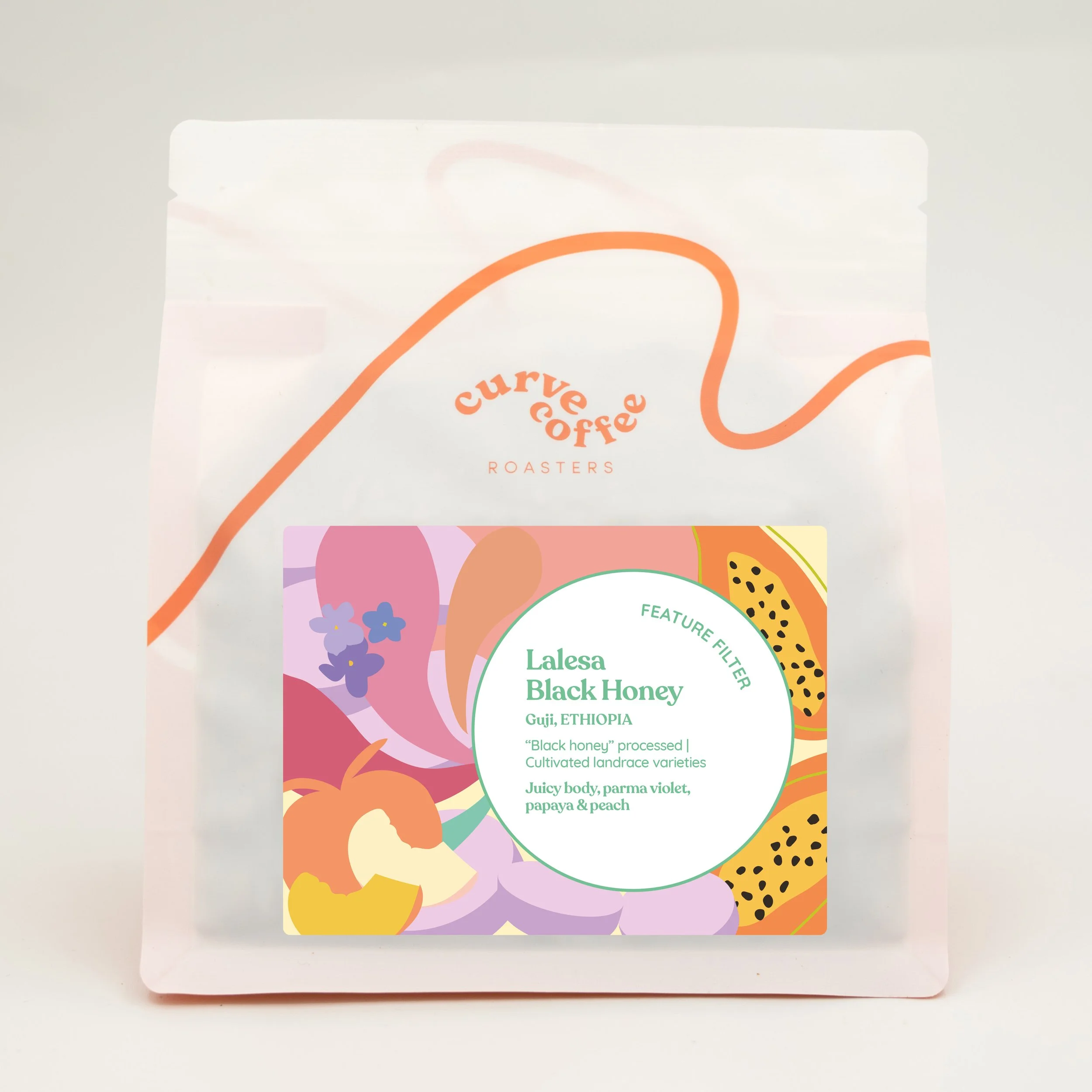
FEATURE FILTER | Lalesa (Black Honey) | Ethiopia
Curve Coffee Roasters
Violet FloralsBlueberriesNectarines
Process Honey
BrewFilter

“Black honey” processed lot of local landrace varieties produced at Lalesa processing site owned and run by the Ephtah coffee exporters team. Cherries are first left to oxidise for one day before being de-pulped and then dried on raised beds for 25 days. Jammy body, violet florals, blueberries & nectarines Great for pourovers, drip filter machines, aeropress and cafetiere. Best enjoyed on its own.

£16.50 / 250g£6.60/100g
Wubit Bekele. Ethiopia. Yirgacheffe.
Girls Who Grind Coffee
Region Chelichele, Yirgacheffe
Producer Wubit Bekele
Process Natural

Strawberry, Jasmine Tea, Watermelon We LOVE Ethiopian coffee at GWGC. This is for you if you like floral, fruity, and delicately sweet notes in your coffee. Great for both filter and espresso. Wubit Bekele is the founder of Ephtah. After working for one of Ethiopia’s largest exporters for many years, she set up Ephtah with the intention of empowering women farmers and breaking down the barriers holding them back. As a Q-Grader, she is obsessed with finding the highest-quality coffee in Ethiopia. She cups every lot that Ephtah buys and exports. Wubit believes in the enormous potential of the Ethiopian coffee sector. She is convinced that by taking a holistic approach, in partnership with clients, the coffee sector can be the main driver of change in Ethiopia.

£14.29 / 250g£5.72/100g
Hambella Washed
Horsham Coffee Roaster
ComplexPeachLimeChocolate
Process Washed
Altitude Importer
BrewFilter

Hambella Washed Varietal – Dega, Kudhume and Wolisho varietalsPreparation – WashedLocation – Guji zoneAltitude – 1900-2200 maslImporter - DR Wakefield Hambella was founded by brothers Aman and Michael Adinew — Aman previously ran quality control at the Ethiopia Commodity Exchange and set up the country's first speciality coffee lab, so this farm was always going to be about doing things properly. It's a big operation for the Guji zone, 200 hectares with a core team of 28 that swells to over 700 come harvest, 70% of them women, and there's a real effort to bring smallholders in the area up to speed too, working alongside agronomists to improve their own coffee. This natural lot is processed just over the border in Gedeb, Gedeo zone, dried slowly on raised beds for 21 days and turned by hand throughout, which is where all that jammy sweetness and fruit character comes from. Grown between 1900–2200m from a mix of Dega, Kudhume and Wolisho varietals, and scoring an impressive 87 points! Tasting notes are complex and include peach, lime and chocolate.

£14.50 / 250g£5.80/100g
Ethiopia, Haro Sorsa
Kiss the Hippo
JasmineBlueberry
Producer Abebe Mitiku, outgrower partner of Dimtu Coffee Industry since 2015
Process Honey
Altitude 2,100 - 2,300 masl

Producer Abebe Mitiku, outgrower partner of Dimtu Coffee Industry since 2015 Farm/Mill Abebe Mitiku's farm, 4 hectares. Processed by Dimtu Coffee Location Haro Sorsa village, Hambela Wamena, East Guji, Oromia Region, Ethiopia Altitude 2,100 - 2,300 masl Process Honey Cultivar Ethiopian Heirloom Harvest November - December Expect notes of Jasmine, Blueberry, Toffee Abebe Mitiku farms four hectares at Haro Sorsa, in the Hambela Wamena district of East Guji, and has supplied red cherry to Dimtu Coffee since 2015. His heirloom trees sit between 2,100 and 2,300 metres on rich volcanic soil. At that altitude the cherry matures slowly, developing the delicate florals and ripe fruit for which Ethiopia is celebrated. Selectively picked, then dried with the mucilage intact, a honey process that layers additional sweetness over that foundation. Certified organic and Rainforest Alliance. Jasmine and blueberry over a soft toffee sweetness, bright and delicate.

£14.40 / 250g£5.76/100g
Ethiopia, Shoondhisa
Kiss the Hippo
PeachStrawberry
Producer Ture Waji (Sookoo Coffee)
Process Natural
Altitude 2,000 - 2,150 masl

Producer Ture Waji (Sookoo Coffee) Farm/Mill Dambi Uddo Drying Station Location Shakiso, Guji Zone, Oromia, Ethiopia Altitude 2,000 - 2,150 masl Process Natural Cultivar Gibirinna 74110 & Serto 74112 Harvest January 2026 Expect notes of Peach, Strawberry, Jasmine Shoondhisa is a hamlet in the hills above Shakiso, in Ethiopia's Guji Zone. Smallholders here grow the local Gibirinna 74110 and Serto 74112 varieties at over 2,000 metres, where cool nights let cherries ripen slowly and build sweetness. Their harvest is processed by Ture Waji of Sookoo Coffee at the Dambi Uddo drying station, a producer who has done as much as anyone to put Guji naturals on the map. Only ripe cherries make the cut, hand sorted and dried whole on raised beds for 18 to 21 days. The cup is pure Guji: ripe peach, juicy strawberry, jasmine, and a syrupy sweet finish.

£12.40 / 250g£4.96/100g
Arsosala
Origin Coffee Roasters
GrapefruitBlueberryJasmine
Region Uraga, Guji
Producer 1,200 smallholders
Process Washed
Variety Heirloom
Altitude 1,800-1,900 masl

An outstanding example of Ethiopian heirloom coffee varieties, Arsosala balances vibrant citrus and blueberry flavour notes with elegant, tea-like character.

£14.70 / 250g£5.88/100g
Ethiopia Doyo Washed Nº 371
Rave Coffee
Malt ChocolateRaisinSalted Caramel
Process Washed
Altitude 1900m-2000m

From the home of coffee itself, comes this washed lot from the Doyo Co-operative. The heirloom varietals grown here represent the legacy of coffee growing in this region - classic flavours and high desirability. This coffee was roasted to pull out the complex sweetness of sweet and salty malted milk chocolate whilst retaining a deep fruit note of raisin and subtle citrus flavour.

£9.80 / 250g£3.92/100g

Explore related browse pages

These links switch to another browse view. The matching coffees for this page are shown above.